
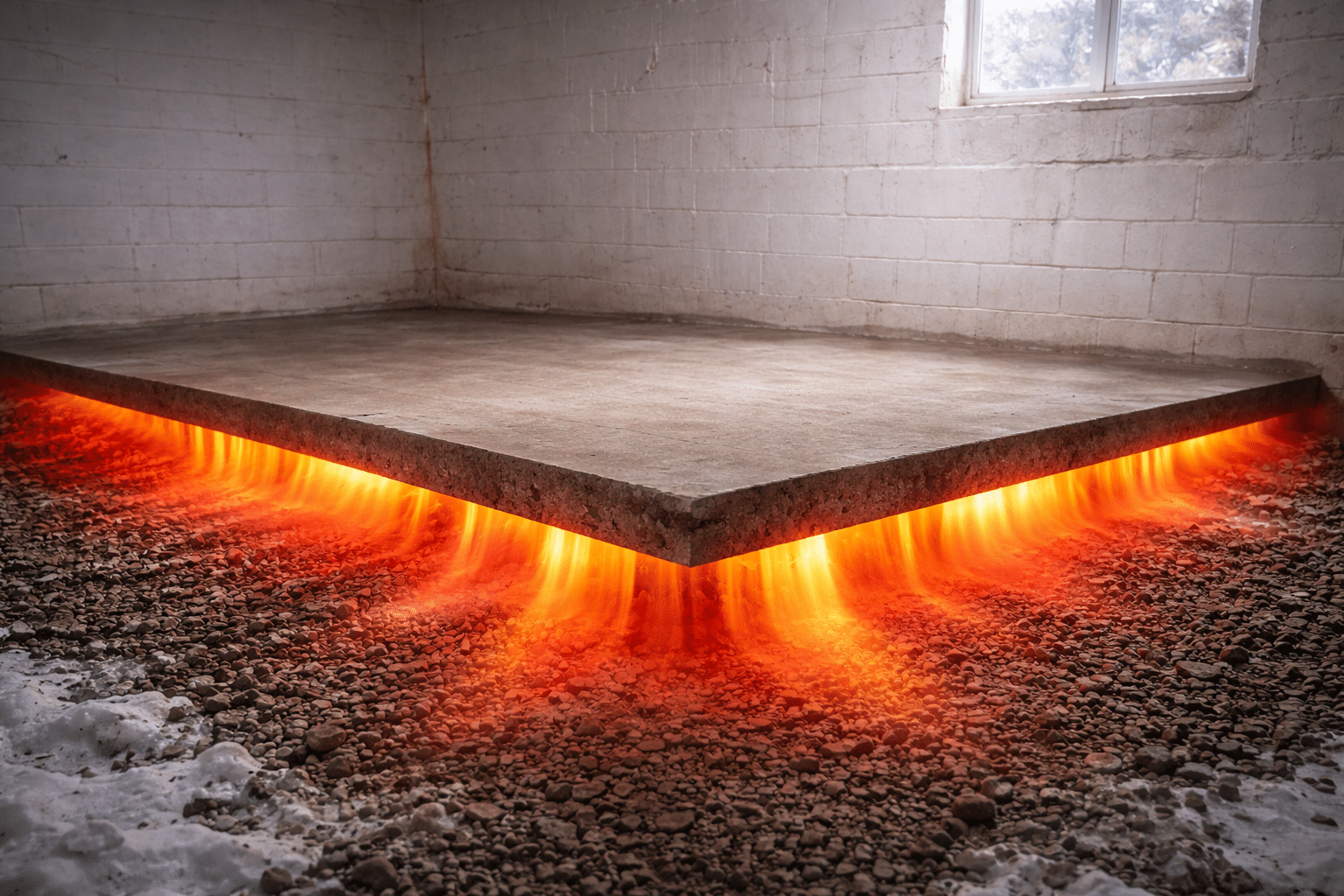
Concrete floors are often treated as passive structural elements, but in Ontario’s climate, they can become major contributors to building heat loss. When concrete slabs are uninsulated or poorly insulated, they act as continuous heat sinks, drawing energy out of the building and into the ground below.
This problem is frequently overlooked during design and construction because it does not present as an obvious failure. There are no visible drafts, leaks, or immediate structural issues. Instead, the impact shows up over time through higher energy use, uneven thermal performance, and increased strain on heating systems.
Understanding how and why concrete floor heat loss occurs is the first step toward preventing long-term performance issues.
How Heat Moves Through Concrete Slabs
Concrete has high thermal mass, meaning it absorbs and transfers heat efficiently. When a slab is in direct contact with cold soil, heat flows steadily from the conditioned interior space into the ground. In Ontario, where ground temperatures remain low for much of the year, this transfer is continuous.
Unlike walls and roofs, which are almost always insulated by default, slabs are sometimes left uninsulated or under-insulated. As a result, the concrete becomes a direct pathway for ground heat transfer. The larger the slab area, the greater the cumulative energy loss.
This process does not stop once indoor air reaches a set temperature. The slab continues to draw heat, forcing heating systems to operate longer and harder to compensate.
An overview of how insulated slab assemblies interrupt this heat transfer is outlined on Reitzel’s slab insulation systems page.
Why Slab Heat Loss Is Often Overlooked
Slab-related heat loss is difficult to detect without deliberate evaluation. It rarely presents as a single, identifiable problem. Instead, it contributes to a series of performance symptoms that are often attributed to other causes.
These symptoms may include:
- Higher-than-expected heating costs
- Cold-adjacent zones near floor level
- Mechanical systems that struggle to maintain stable temperatures
- Buildings that underperform energy models or expectations
Because slabs are buried beneath finished floors, insulation deficiencies are easy to ignore once construction is complete. Retrofitting slab insulation after the fact typically involves major disruption, making prevention at the design stage far more practical.
In many cases, this heat loss is not caused by a lack of insulation alone, but by insulation that was never selected for the real loads and conditions of the building. This is explored further in how slab insulation must be matched to comfort and load performance requirements.
The Role of Climate in Ontario Slab Heat Loss
Ontario’s seasonal conditions make slab heat loss especially relevant. During winter months, ground temperatures remain consistently cold, even when outdoor air temperatures fluctuate. This creates a persistent temperature gradient between the interior slab surface and the soil below.
In the Waterloo Region and across Southern Ontario, this condition can persist for several months at a time. The result is long-duration energy loss rather than short-term inefficiency. Over the life of a building, this can represent a significant performance penalty.
Heat Loss Across Different Building Types
Concrete floor heat loss affects buildings differently depending on their size, use, and load conditions.
In residential and light commercial buildings, uninsulated slabs can quietly undermine overall energy efficiency. While the effects may not be immediately dramatic, the ongoing heat transfer increases operating costs and reduces the effectiveness of other insulation measures.
In these environments, load-rated systems such as HC-40 slab insulation or HC-60 slab insulation systems are commonly used. These solutions provide a balance between thermal performance and the ability to support typical residential or light commercial loads.
In larger commercial and industrial buildings, the consequences are more pronounced. Large slab footprints, extended operating hours, and higher heating demands amplify the effects of slab heat loss. Over time, this can place measurable strain on mechanical systems and contribute to higher lifecycle costs.
For these applications, HC-100 commercial insulation solutions are used to limit ground heat transfer while supporting heavy static and dynamic loads.
Slab Heat Loss as a Performance Failure
Cold floors are often treated as a comfort issue, but slab heat loss is more accurately described as a performance failure. It represents energy leaving the building envelope through a pathway that should have been controlled.
From a building science perspective, an uninsulated slab undermines the effectiveness of wall and roof insulation. Even a well-insulated envelope cannot perform as intended if heat is continuously escaping through the floor assembly.
This is why slab insulation should be evaluated as part of a complete building performance strategy, not as an optional upgrade.
How Slab Insulation Addresses the Issue
Proper slab insulation creates a thermal break between the concrete and the ground. This significantly reduces heat transfer, stabilizes interior conditions, and improves the predictability of building performance.
When insulation is selected with appropriate compressive strength, it also maintains its shape and effectiveness under long-term loads. This is critical in environments where vehicle traffic, equipment, or storage systems apply sustained pressure to the slab.
Correctly specified slab insulation supports:
- Reduced heat loss through the floor
- Improved energy efficiency
- More consistent interior temperatures
- Long-term durability of the slab assembly
Ignoring slab heat loss does not usually lead to immediate failure, but it locks in inefficiency for the life of the building.
Making Slab Heat Loss a Design Priority
Once a concrete slab is poured, insulation decisions are effectively permanent. This makes early evaluation and correct specification essential, particularly in Ontario’s climate.
For builders, designers, and facility managers, slab insulation should be treated as a foundational performance system. Addressing slab heat loss at the design stage prevents avoidable energy waste and supports long-term building efficiency.
For a deeper look at how slab insulation is selected based on traffic loads, equipment weight, and long-term use, see how slab insulation improves comfort and load performance in Ontario buildings.
Book a consultation to assess slab heat loss in your building.
For project-specific guidance, contact Reitzel through their slab insulation consultation team.