
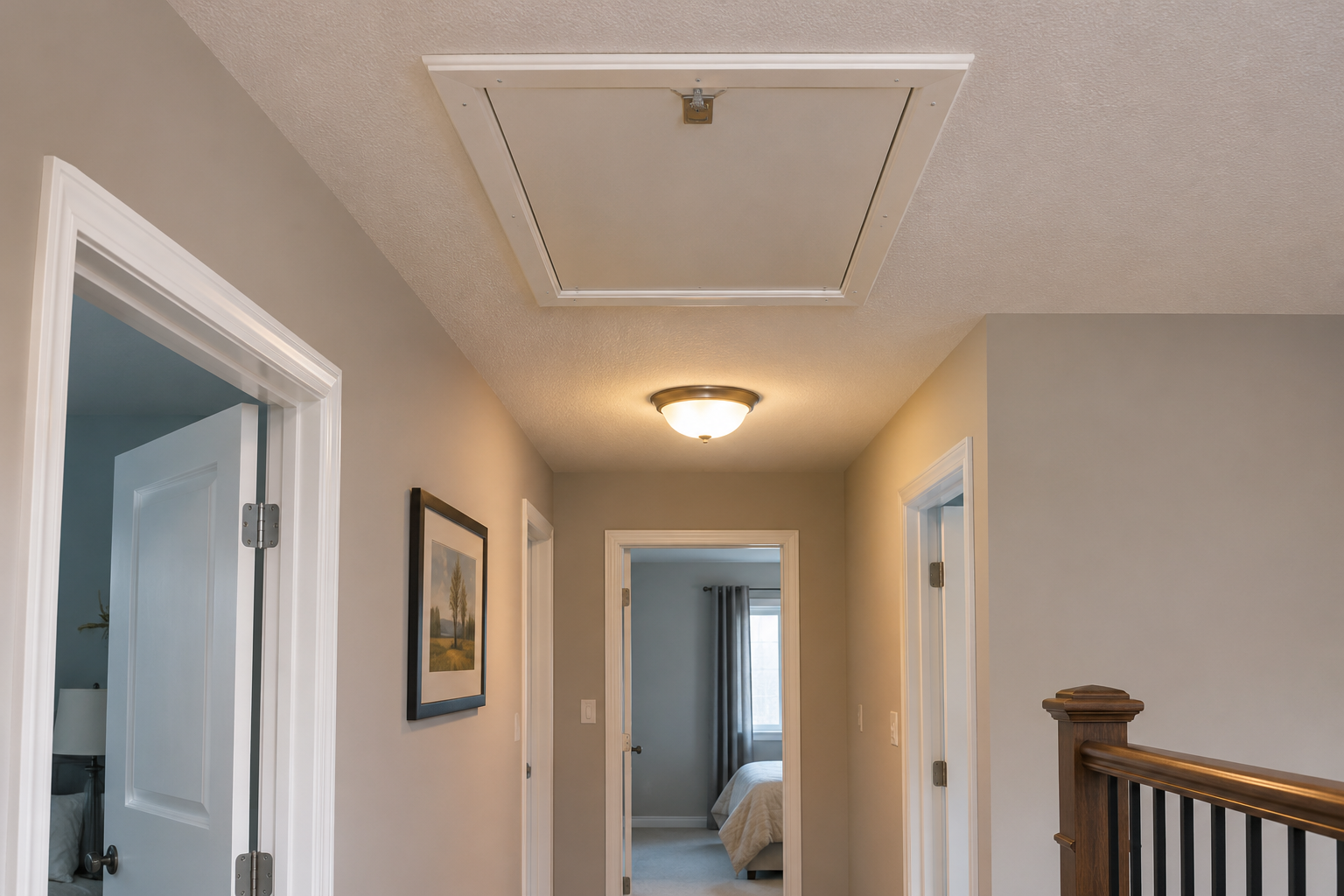
Have you noticed that your upstairs hallway feels colder than the bedrooms around it? This temperature difference can become particularly noticeable during fall and winter, even when your heating system appears to be working normally.
Homeowners often investigate windows, exterior walls, or heating equipment when certain areas of their homes feel uncomfortable. However, the attic access hatch is another potential source of heat loss that can easily be overlooked.
In some Ontario homes, inadequate attic hatch insulation or gaps around the access opening can contribute to unwanted heat transfer and air movement. Understanding how these conditions develop can help determine whether the hatch deserves closer attention.
Why the Attic Hatch Is Different From the Rest of Your Ceiling
Your ceiling is part of the building envelope that separates heated living spaces from the attic. When properly installed, ceiling insulation helps limit heat transfer between these areas and supports more consistent indoor temperatures.
An attic hatch creates an interruption in this otherwise continuous assembly. Unlike the surrounding ceiling, the attic access panel must be removable or operable to provide access for inspections, maintenance, and other work.
This difference creates several potential weaknesses.
The hatch panel may contain less insulation than the surrounding ceiling. Its frame may also have small gaps, while weatherstripping around the perimeter can become damaged, compressed, or displaced over time.
Even when the surrounding attic insulation is performing adequately, inconsistent attic access insulation can create a localized area where heat moves more readily.
For homeowners experiencing a cold upstairs hallway, this interruption is worth investigating, particularly when the attic entrance is directly above the affected space.
How an Attic Hatch Can Allow Heat to Escape
An attic hatch can contribute to heat loss through two separate mechanisms: heat transfer through the panel and air leakage around the opening.
Understanding the difference matters because insulation and air sealing perform different functions.
Heat Transfer Through a Poorly Insulated Hatch
Heat naturally moves from warmer areas toward colder areas. During an Ontario winter, heated indoor air and interior surfaces are generally warmer than the unconditioned attic above.
If the hatch contains insufficient insulation, heat can transfer through the panel more readily than through the surrounding insulated ceiling.
This can result in a cooler ceiling surface near the attic entrance. Depending on the home’s layout and other conditions, the temperature difference may contribute to discomfort in the hallway below.
Adequate attic hatch insulation helps reduce this heat transfer by improving the thermal resistance of the access panel.
Air Leakage Around the Hatch Opening
Air leakage is a separate concern.
Small openings between the hatch panel and its frame can allow warm indoor air to move into the attic. Temperature differences, wind, and pressure conditions within the home can influence this movement.
These attic hatch air leaks may also contribute to noticeable drafts or localized temperature differences near the opening.
Weatherstripping and appropriate air sealing help limit airflow through gaps. However, adding insulation to the panel alone does not necessarily correct an ineffective perimeter seal.
Both conditions should be considered when investigating attic heat loss around an access opening.
Signs Your Attic Hatch May Be Part of the Problem
A cold upstairs hallway does not automatically indicate a defective attic hatch. Heating distribution, exterior walls, windows, and other building-envelope conditions can also influence indoor comfort.
However, certain observations may suggest that the attic access opening deserves closer inspection.
Common indicators include:
- Localized cold drafts: Air movement seems more noticeable directly beneath or near the attic entrance.
- Temperature differences: The hallway feels colder than nearby rooms, particularly during colder weather.
- Damaged weatherstripping: Sealing material around the hatch appears loose, worn, compressed, or missing.
- Visible perimeter gaps: The access panel does not sit evenly or securely against its frame.
- Limited panel insulation: The hatch appears uninsulated or has noticeably less insulation than the surrounding ceiling.
- Poor panel fit: The hatch shifts, sits unevenly, or does not close consistently.
These observations are useful starting points, but they are not definitive proof of attic hatch air leaks or inadequate insulation.
A professional assessment can help distinguish a localized hatch problem from other conditions affecting home comfort.
Why Adding More Attic Insulation May Not Fix the Hatch
When homeowners suspect attic heat loss, adding more insulation across the attic floor may seem like the obvious solution.
However, increasing insulation coverage does not automatically correct weaknesses at the attic access opening.
For example, additional insulation installed across the attic floor will not necessarily improve a poorly insulated hatch panel. It also will not seal gaps between the panel and its frame.
The access opening requires separate consideration because its construction and function differ from the surrounding ceiling.
This distinction is important when evaluating attic access insulation. The goal is not simply to increase insulation throughout the attic but to determine whether the hatch and surrounding assembly provide adequate thermal resistance and air sealing.
In some cases, targeted improvements around the access opening may be appropriate. In others, the hatch may be only one of several conditions requiring attention.
What Should Be Checked Before Making Improvements
A thorough evaluation should consider the attic hatch as a complete assembly rather than focusing only on the removable panel.
Several components can influence its performance.
Hatch Insulation and Panel Condition
The inspection should determine whether the hatch has adequate insulation and whether that insulation remains securely positioned.
The panel’s condition, construction, and fit also matter. Damaged or poorly fitted components can reduce the effectiveness of otherwise suitable insulation.
Perimeter Sealing and Frame Condition
Weatherstripping should form an effective seal when the hatch is closed.
The attic hatch frame should also be examined for gaps, damage, or movement that could allow unwanted airflow.
Where appropriate, air-sealing improvements may help address leakage around fixed joints or nearby penetrations. Materials and methods should be selected for the specific application rather than assuming one product is suitable everywhere.
For some building-envelope applications, spray foam insulation may be considered as part of a broader insulation or air-sealing approach. However, it is not automatically the appropriate material for a removable attic hatch or its operable seal.
Surrounding Insulation and Moisture Conditions
The inspection should also consider whether ceiling insulation remains continuous around the attic opening.
Nearby attic penetrations, insulation gaps, and signs of condensation or moisture should be evaluated where relevant.
Moisture concerns deserve particular attention because warm indoor air entering a cold attic can carry water vapour that may condense on colder surfaces.
Any proposed improvements must preserve safe attic access and avoid obstructing required ventilation.
When a Professional Attic Assessment Makes Sense
Homeowners in Waterloo Region, Cambridge, Hamilton, Guelph, and surrounding Southern Ontario communities may notice hallway comfort differences more readily as outdoor temperatures fall.
If a cold upstairs hallway remains uncomfortable despite normal heating operation, or if visible gaps and damaged weatherstripping are present, a professional attic assessment may be worthwhile.
An evaluation can help determine whether the concern involves attic hatch insulation, perimeter air leakage, surrounding ceiling insulation, or another building-envelope condition.
Reitzel Insulation’s Roof or Attic insulation services provide a starting point for homeowners seeking guidance on attic insulation conditions and potential improvements.
Identifying the source of the problem before choosing materials or repairs helps keep recommendations focused on the actual conditions found.
Improve the Weak Point Before Assuming the Whole Attic Needs Work
An attic hatch is a small component of the ceiling, but its insulation and air-sealing performance can influence the area directly below it.
When an upstairs hallway feels unusually cold, the access panel, perimeter seal, and surrounding insulation deserve consideration alongside other possible causes.
The appropriate solution may involve improving the hatch, addressing surrounding air leakage, correcting insulation gaps, or investigating another source of heat loss.
A targeted assessment can help establish which improvements are justified without assuming the entire attic requires additional insulation.
Concerned that your attic access may be contributing to a colder upstairs hallway? Contact Reitzel to discuss an attic insulation assessment.