
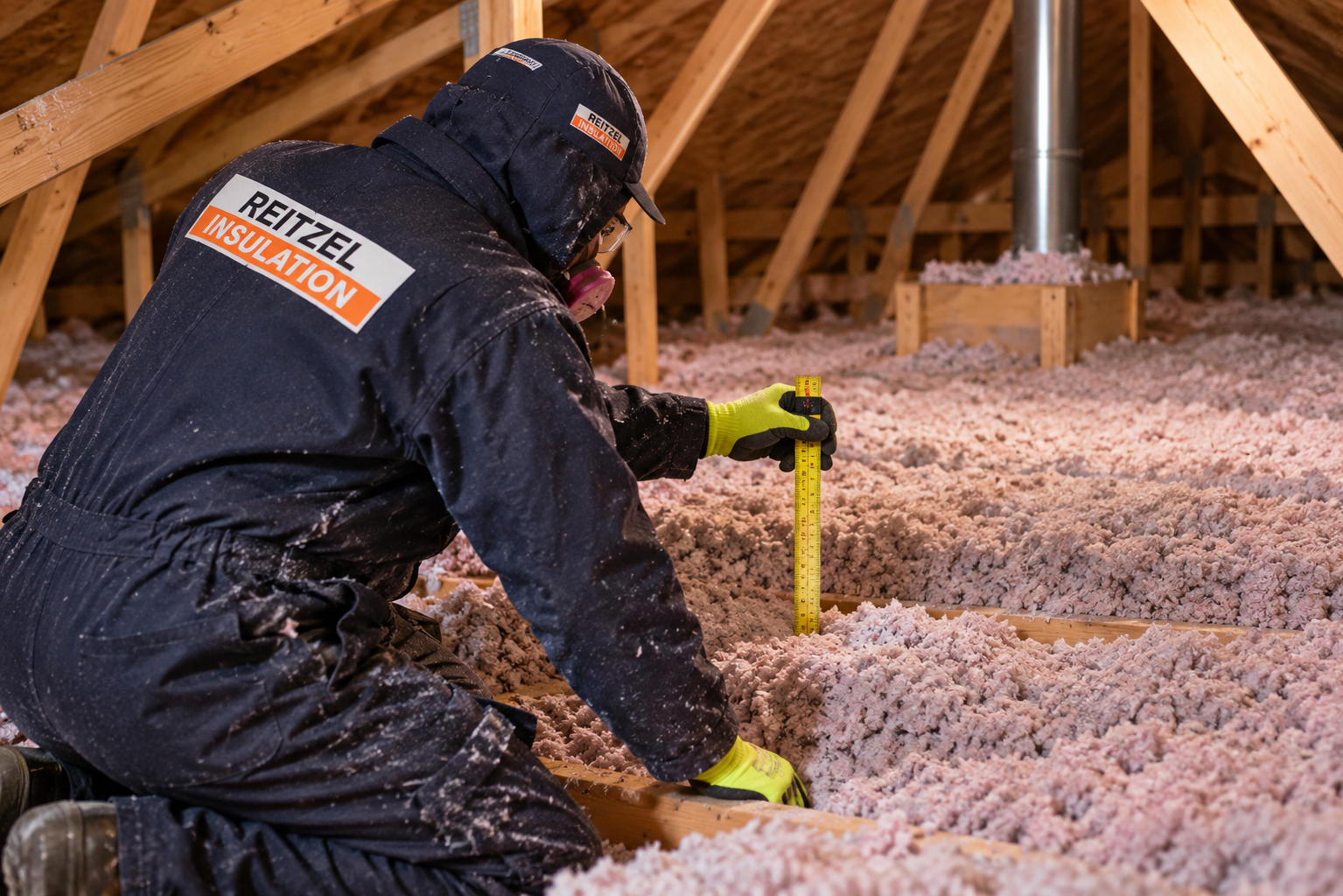
Why Homeowners Focus on Insulation Depth
When homeowners look into an attic, insulation depth is one of the easiest things to notice. A thick, consistent-looking layer can create the impression that the attic is well insulated and performing as intended.
That assumption is understandable because insulation quantity is often discussed in terms of thickness and R-value. However, attic insulation depth is only one part of the picture. Effective Roof or Attic Insulation also depends on the insulation material, its condition, coverage, installation quality, and how well the attic limits unwanted air movement.
For homeowners across Waterloo Region, Cambridge, Hamilton, Guelph, and Southern Ontario, these factors can be particularly important when assessing an existing home. An attic may contain a substantial amount of insulation while still having areas where thermal performance is reduced.
The goal is not to assume that deep insulation indicates a problem. Instead, homeowners should recognize that depth alone cannot confirm how well the entire attic is performing.
Depth and R Value Are Not the Same Thing
Insulation is commonly evaluated using R-value, which describes resistance to heat flow. Different insulation materials provide different levels of thermal resistance at a given thickness, so two materials at the same depth may not provide the same R-value.
This distinction matters when evaluating attic insulation Ontario homeowners already have in place. Measuring the insulation without identifying its type may provide an incomplete picture of its thermal resistance.
The attic insulation R value can also be affected by the condition and installation of the material. Insulation that has settled, shifted, or been compressed may not perform in the same way as properly installed material in good condition.
For that reason, attic insulation depth should be considered alongside material type and condition. A measurement can be useful, but it becomes more meaningful when it is part of a broader insulation assessment.
What Can Reduce the Performance of Existing Insulation
Insulation does not necessarily remain in its original condition throughout the life of a home. Attics may be accessed for electrical work, roofing projects, ventilation changes, pest control, or other maintenance. These activities can disturb insulation and create areas with inconsistent coverage.
Insulation settling can also occur over time depending on the material and installation. In other situations, compressed insulation may provide less effective thermal resistance than expected for the space it occupies.
Coverage is another important factor. One easily visible section of an attic may have substantial insulation while areas near exterior edges, framing, attic hatches, or mechanical components have uneven insulation or insulation gaps.
Moisture can create additional concerns. Attic moisture may affect some insulation materials and can also indicate that ventilation, air movement, or other parts of the attic assembly should be investigated.
None of these conditions can be identified reliably from attic insulation depth alone. Looking at the condition and distribution of the insulation provides a better understanding of overall attic insulation performance.
Why Gaps and Air Leaks Matter
Insulation works as part of the home’s broader building envelope. Its job is related to controlling heat flow, while air sealing addresses unwanted air movement through gaps and penetrations in the assembly.
An attic can therefore have significant insulation depth while still allowing air leakage. Openings around wiring, plumbing, lighting, ducts, framing connections, and other penetrations may provide pathways for conditioned indoor air to move into the attic.
Insulation placed over these areas does not necessarily eliminate the underlying leakage. This is one reason why simply adding more insulation is not always the complete solution to heat loss.
The appropriate approach depends on the attic assembly, existing materials, and project conditions. In some applications, products such as Spray Foam Insulation can form part of a strategy for improving insulation continuity and controlling air movement.
The important distinction is between having insulation present and having an attic assembly that performs effectively. Coverage and air sealing need to be considered together rather than judged by visible depth alone.
What a Professional Attic Assessment Looks Beyond
A professional insulation assessment provides context that a quick visual check from the attic hatch cannot. Instead of asking only how many inches of insulation are present, an assessment considers the condition of the attic as a system.
This can include identifying the insulation material, reviewing coverage, looking for compressed or disturbed areas, and checking locations where insulation may be missing or uneven. Signs of attic moisture and potential air leakage can also help explain why a home may not be performing as expected.
The attic insulation R value should also be considered in relation to the material and assembly rather than estimated from depth without context. Requirements and appropriate insulation levels can vary according to the project, location, construction details, and applicable standards.
A fuller assessment is particularly useful when homeowners are experiencing comfort concerns or considering an attic upgrade. It can help distinguish between an attic that simply needs additional insulation and one where other conditions should be addressed first or at the same time.
When an Attic Insulation Upgrade Makes Sense
An attic insulation upgrade should respond to the actual conditions in the attic rather than appearance alone. In some homes, additional insulation may be appropriate because the existing thermal resistance is insufficient for the intended assembly.
In other homes, the existing attic insulation depth may appear substantial, but uneven insulation, gaps, air leakage, compression, or moisture-related damage may be limiting attic insulation performance. Adding more material without understanding those conditions could leave important issues unaddressed.
This is why there is no single visual measurement that tells every homeowner whether an attic needs improvement. Attic insulation Ontario homes require should be considered in the context of the building, existing materials, installation quality, and applicable requirements.
A well-performing attic depends on more than how deep the insulation looks. Material type, attic insulation R value, coverage, condition, air leakage, and installation quality all contribute to the overall result.
If you are uncertain about how your existing insulation is performing, have the insulation professionally assessed rather than relying on appearance or depth alone. A complete insulation assessment can help identify where improvements are actually needed and provide a clearer basis for deciding whether an attic insulation upgrade makes sense.