
Homeowners researching insulation options often begin with one question: how much will it cost? While budget is an important consideration, the true value of an insulation project goes beyond the initial investment. Factors such as energy efficiency, air sealing performance, lifespan, installation requirements, and overall home efficiency all play a role in determining which solution makes the most sense.
When comparing the spray foam vs blown-in insulation cost, it is important to understand that each product serves a different purpose and performs differently depending on the area being insulated. Homeowners exploring spray foam insulation should consider both upfront costs and long-term performance when evaluating insulation options.
Rather than focusing exclusively on the lowest initial expense, homeowners can benefit from looking at insulation as a long-term investment. The right insulation upgrade can contribute to improved comfort, reduced energy loss, and better overall building performance for years to come.
Understanding the Difference Between Spray Foam and Blown-In Insulation
Before comparing the spray foam vs blown-in insulation cost, it helps to understand how these insulation systems work and where they are commonly used.
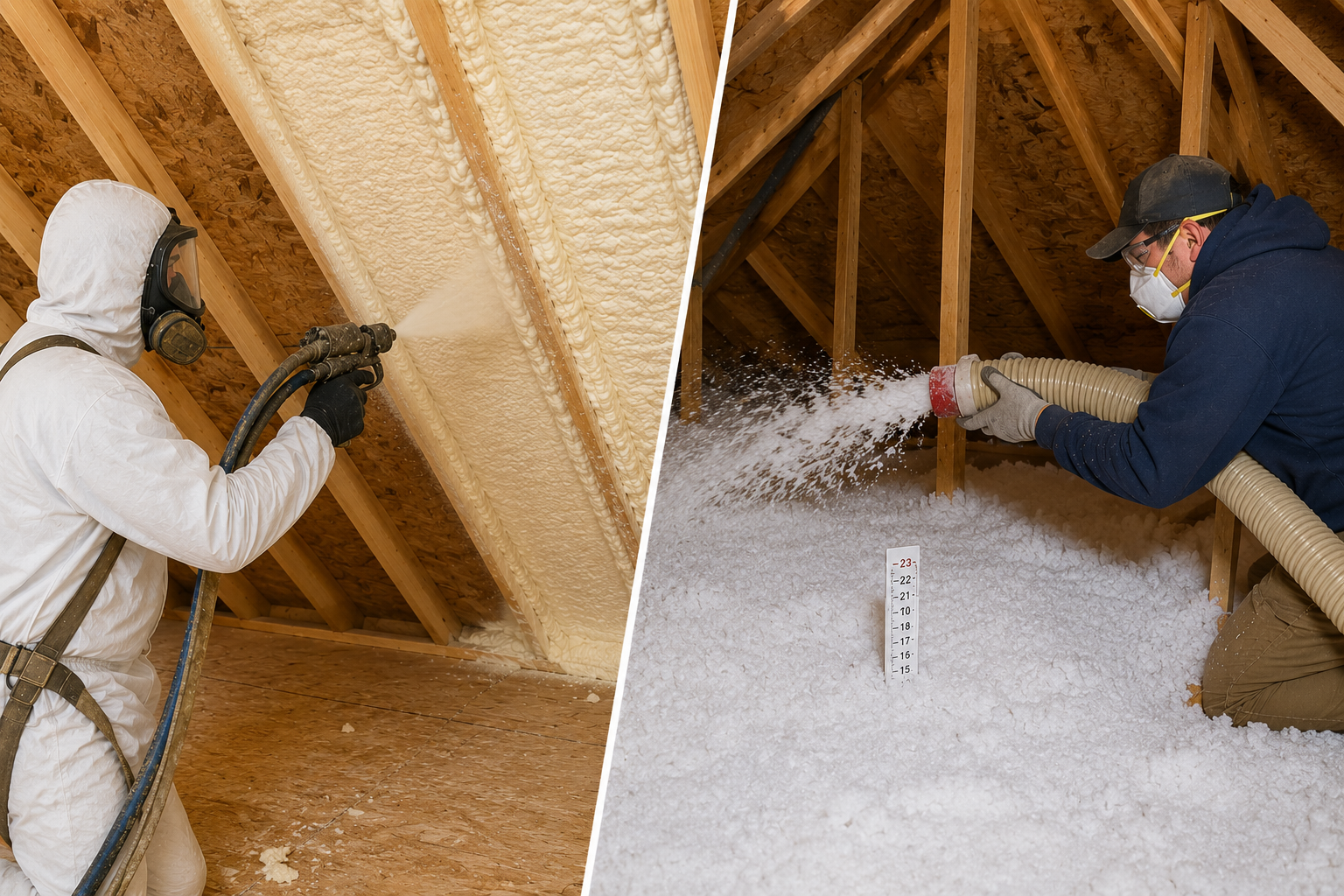
Spray foam insulation is applied as a liquid that expands after installation. Once cured, it creates a continuous insulation layer that can help reduce air leakage while providing thermal resistance. Because it combines insulation with air sealing, spray foam is often used in areas where limiting unwanted airflow is a priority.
Blown-in insulation consists of loose insulation material that is mechanically distributed into attics, wall cavities, and other spaces. It is designed to create a consistent insulation blanket that helps slow heat transfer and improve energy efficiency.
While both systems improve thermal performance, they accomplish this in different ways. Spray foam focuses on both insulation and air sealing, while blown-in insulation primarily increases thermal resistance through additional insulation coverage.
Understanding these distinctions is essential when evaluating the spray foam vs blown-in insulation cost because each solution may provide different benefits depending on the project goals.
What Factors Affect Insulation Costs
Homeowners frequently search for information about spray foam insulation cost Ontario, blown-in insulation cost Ontario, and general insulation pricing. However, insulation projects are highly variable, making exact cost comparisons difficult without a site assessment.
Several factors influence project costs:
Size of the Area
Larger spaces require more materials and labour. An attic insulation project will typically have different requirements than insulating a crawl space, basement, or wall assembly.
Accessibility
The ease of accessing the installation area can affect labour requirements. Tight crawl spaces, enclosed wall cavities, and complex roof structures may require additional preparation and installation time.
Existing Insulation Conditions
Current insulation levels often influence project recommendations. In some homes, existing insulation may be adequate in certain areas but insufficient in others. Moisture damage, settling, or contamination may also need to be addressed before new insulation is installed.
Desired Performance Outcomes
Homeowners may have different goals for their insulation investment. Some prioritize lower heating and cooling costs, while others focus on comfort, draft reduction, moisture management, or overall home efficiency. These objectives can influence which insulation solution is recommended.
Material and Installation Requirements
Specialized installation procedures can affect overall spray foam insulation pricing and project scope. Similarly, attic upgrades involving blown-in insulation may vary depending on the amount of insulation required to reach desired R-value targets.
Because every home is different, evaluating the spray foam vs blown-in insulation cost should involve more than comparing material prices alone.
Where Spray Foam Insulation Performs Best
When discussing spray foam insulation cost Ontario, it is important to understand where spray foam often delivers the greatest value.
One of the most significant advantages of spray foam is its air sealing capability. Air leakage can contribute substantially to heat loss during Ontario winters and unwanted heat gain during warmer months. By helping reduce airflow through gaps and cracks, spray foam can support improved energy performance.
Spray foam is commonly used in:
- Rim joists
- Crawl spaces
- Wall cavities
- Cathedral ceilings
- Basement areas
- Certain roof assemblies
Its ability to expand and conform to irregular surfaces makes it particularly useful in areas where achieving a complete air barrier is important.
Homeowners evaluating spray foam insulation pricing often consider long-term energy savings, indoor comfort improvements, and building durability. In many applications, the value of spray foam comes from its combined insulation and air sealing performance rather than insulation alone.
This is why discussions about spray foam vs blown-in insulation cost should consider how the insulation will function within the overall building envelope.
Where Blown-In Insulation Performs Best
Blown-in insulation remains one of the most common solutions for residential attic insulation projects throughout Southern Ontario.
For homeowners researching blown-in insulation cost Ontario, attic upgrades are often the primary focus. Many existing homes have insufficient attic insulation by current standards, making additional insulation an effective way to improve thermal performance.
Blown-in insulation is frequently selected because it:
- Covers large attic areas efficiently
- Fits around obstacles and framing members
- Can increase attic R-value levels
- Helps improve overall home efficiency
- Works well in many retrofit situations
Homeowners comparing blown insulation prices often find that blown-in insulation provides a practical solution for increasing insulation coverage in accessible attic spaces.
In many homes, attic insulation upgrades can contribute to long-term energy savings by reducing heat transfer through the roof assembly. However, performance depends on factors such as ventilation, existing insulation conditions, and overall building design.
For additional information about applications and installation methods, homeowners can learn more about blown-in insulation.
When comparing the spray foam vs blown-in insulation cost, it is important to remember that these products are often used in different areas for different purposes. One is not automatically better than the other.
Choosing the Right Insulation for Your Home
The most effective insulation strategy often involves matching the right product to the right application.
For example, a homeowner may benefit from blown-in attic insulation while also using spray foam in specific areas where air leakage is a concern. In some situations, both products may be used within the same home to address different performance goals.
When evaluating the spray foam vs blown-in insulation cost, homeowners should consider:
- Current insulation levels
- Air leakage issues
- Moisture concerns
- Home age and construction type
- Desired R-value improvements
- Long-term energy savings potential
- Overall home performance objectives
A balanced approach helps ensure insulation recommendations are based on building needs rather than assumptions about a particular product.
Ultimately, insulation decisions should be guided by performance requirements, budget considerations, and the unique characteristics of the home. What works well in one property may not be the ideal solution for another.
Homeowners considering an insulation upgrade can contact Reitzel Insulation to request a professional assessment and determine the most appropriate solution for their property. Recommendations should be based on the home’s construction, performance goals, and existing insulation conditions, helping homeowners make informed decisions that support comfort, efficiency, and long-term value.